|
|
 Mathematics
is the alphabet with which God wrote the universe - Galileo Galillei Mathematics
is the alphabet with which God wrote the universe - Galileo Galillei |
| One
of the most recurring themes in science fiction is time travel. The ability
to travel backwards and forwards through the ages would a most powerful
asset. Except it would be if it weren't for the huge paradoxes involved.
Like the classic grandfather paradox. If you were to go back in time
and kill your grandfather when he was just a boy, you would have never
been born. But if you had never been born, who killed your grandfather.
Well countless movies and books have been written using time travel as
a part, from H.G Wells' The Time Machine to James Cameron's Terminator.
It's to clear up the paradoxes. Let's
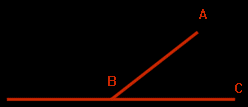
say you have a time line. A horizontal, ordinary straight line. It might
help if you draw this on a piece of paper. Put a dot on the right end of
the line. That's where we are now in time. So time moves from left to right.
Go to a point on the line, and starting there, draw another line branching
away from the main time line. Label the first dot C (the one where
we are now in time). Label the point at which the line branches away B.
And now label the end of the branch off A. You should now have a picture
like the one that follows. Say that you are at point C, and go back in time to point B. As soon as you go back and start altering time, a new time-line starts branching off along the line of AB. To the people on this line (apart from the actual time travellers), AB would be to them like the main line is to us. When time travellers go back, they simply come back to our timeline. But
that could also mean that we are on a branch off.
|
|
Copyright 1999 Nathan Adams |